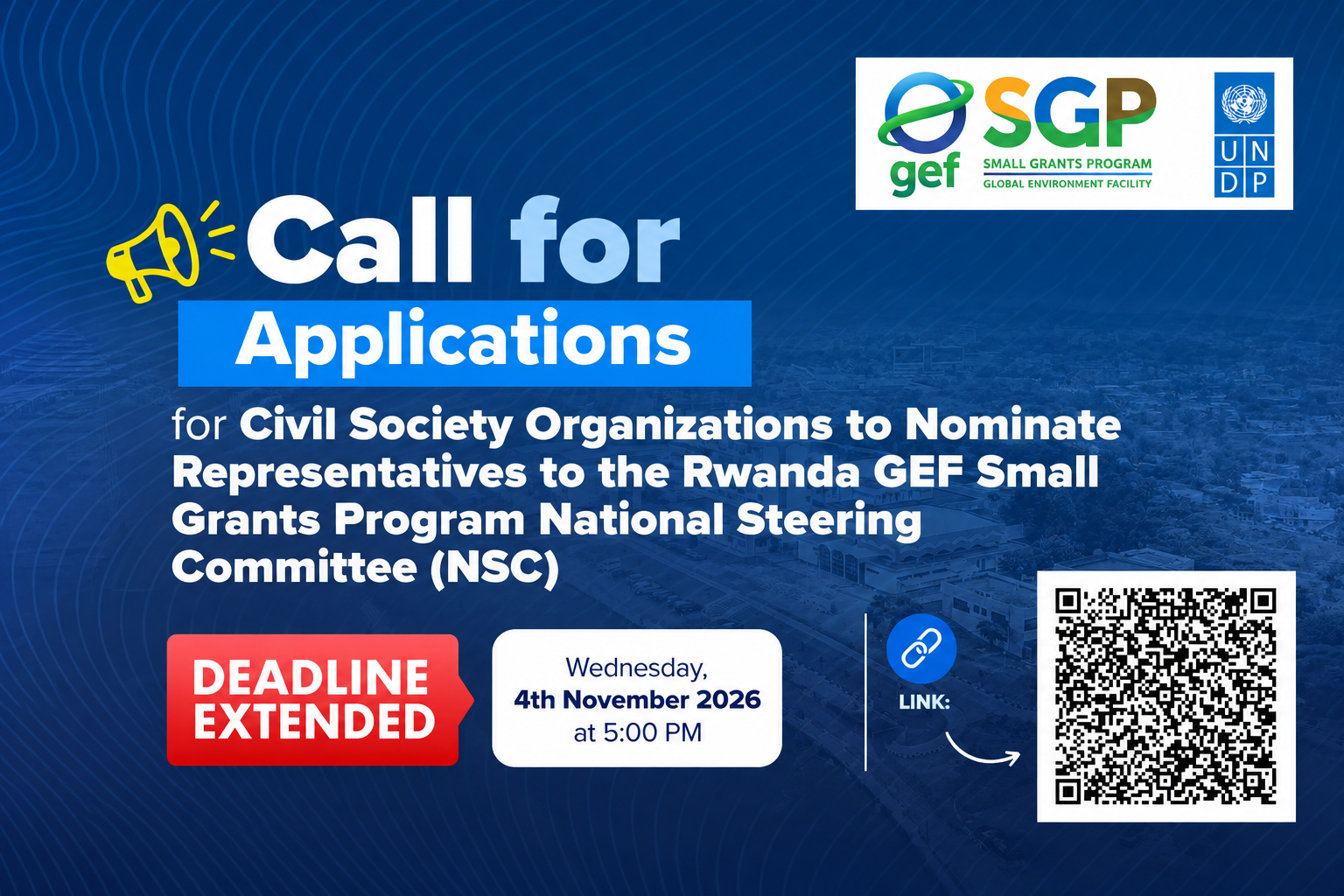
Call for applications for CSOs to nominate representatives to the Rwanda GEF Small Grants Programme National Steering Committee, deadline extended to 4 November 2026 - Rwanda GEF SGP NSC Call 2026: 5 Seats Open, Apply by 4 Nov
Rwanda GEF Small Grants Programme Opens 5 Seats on Its National Steering Committee (Deadline Extended to 4 November 2026)
If you work in conservation, climate action, community development, or environmental policy in Rwanda, this one is worth a close look. The Rwanda GEF Small Grants Programme (SGP), implemented by UNDP, is looking for five new members for its National Steering Committee (NSC). The deadline has been extended, but it’s now very close: Wednesday, 4 November 2026 at 5:00 PM.
About the programme
The GEF Small Grants Programme backs community-level projects that protect the environment while improving people’s livelihoods. The National Steering Committee is the group that guides it in Rwanda. Its members review project proposals, follow the progress of ongoing projects, join subcommittees and working groups, and give policy guidance.
UNDP invites civil society organizations, academic and scientific institutions, and private-sector institutions to nominate qualified candidates for the five vacant seats.
Who they’re looking for
The programme wants people with real, demonstrated experience in one or more of these areas:
- Biodiversity conservation
- Climate change adaptation and mitigation
- Sustainable land and natural resource management
- Community development and livelihoods
- Gender equality and social inclusion
- Youth engagement and participation
- Environmental policy and governance
- Sustainable development and financing
Candidates should also know Rwanda’s national development and environmental priorities well. They must be able to contribute independently, ethically and strategically, and disclose any actual or potential conflicts of interest.
How the committee works
The NSC will have roughly 7 to 12 members, and most will come from the non-governmental sector. That includes NGOs, academic and scientific institutions, women’s organizations and the private sector, plus a limited number of government institutions. The UNDP Country Office (through the SGP focal point) and the GEF Operational Focal Point sit on the committee ex officio.
One point many applicants miss: everyone else serves in a personal capacity. Your nominating institution doesn’t instruct you, and you don’t represent it. You’re expected to use your own independent judgment and act in the best interests of the GEF-SGP.
Key details at a glance
- Vacant positions: 5, mostly drawn from CSO nominations
- Term: 3 years from the date of appointment
- Nature of the role: Voluntary and non-remunerated
- Time commitment: A minimum of 2 and a maximum of 4 NSC meetings per year, depending on the annual work plan
- Deadline: Wednesday, 4 November 2026, 5:00 PM
Eligibility
To apply, you must:
- Be nominated or endorsed by a civil society, academic, scientific or private-sector institution that is legally registered or formally recognized to operate in Rwanda
- Hold a position in, or have a demonstrated professional affiliation with, that institution
- Show relevant qualifications, professional experience, integrity and knowledge in at least one of the thematic areas above
- Be available for the full three-year term and the expected meeting schedule
- Be willing to sign the mandatory Conflict of Interest Statement and disclose any conflicts at the time of appointment and before each relevant meeting
Women-led, youth-focused and community-based organizations are strongly encouraged to apply, along with candidates who add thematic and institutional diversity.
One thing to know before you apply: organizations linked to a sitting NSC member can’t apply for or receive GEF-SGP grants during that member’s term. This protects the fairness of the grant-making process, so think it through if your organization plans to seek SGP funding.
What to submit
Each candidate needs to send four documents:
- An official nomination letter from the nominating institution, confirming your name and contact details, your position or professional affiliation, and the institution’s support for your nomination.
- Proof of the institution’s legal registration or formal recognition to operate in Rwanda.
- Your CV, including a short professional biography and details of your relevant experience.
- A brief motivation letter covering your relevant expertise, what you’d contribute to the NSC, and your availability for the full three-year term.
How candidates are selected
Selection has three stages:
- Eligibility screening to check that all mandatory requirements and documents are in place
- Individual assessment against the approved evaluation matrix, looking at qualifications, experience, thematic expertise and availability
- Collective assessment to make sure the committee as a whole is balanced across civil society, academia and the private sector, with good thematic coverage and gender and youth representation
The proposed composition is reviewed by the existing NSC members (or an alternative arrangement confirmed by the CPMT). The UNDP Resident Representative, in consultation with the National Coordinator, then agrees on the recommended list. Final approval comes from the CPMT Regional Focal Point, coordinated through the UNDP Country Office. The review is expected to take about two weeks after the deadline.
All candidates will be told the outcome by email. Selected candidates will then sign the Conflict of Interest and Confidentiality Declaration Form before UNDP issues nomination letters.
How to apply
Email your complete application to smallgrants.programme.rwanda@undp.org, with a copy to sandrine.kamikazi@undp.org.
Questions about eligibility, requirements or the selection process should be sent in writing to sandrine.kamikazi@undp.org.
The Call for Applications, Terms of Reference, UNDP Operational Guidelines and the Conflict of Interest Statement are all available for download on the official UNDP Rwanda page: Link
A few practical tips
- Start with the nomination letter. It depends on your institution, so ask for it today if you haven’t already.
- Keep the motivation letter focused. Name the thematic areas you know best and say plainly what you’d bring to project selection and oversight.
- Check that your documents are complete before you hit send. Incomplete applications can fail the first screening.
- Send early. With the deadline on 4 November at 5:00 PM, don’t leave it to the last hour.
Need help with your application?
If you need support putting together your CV, motivation letter or nomination documents, our team can help. Call or WhatsApp +250 784 868 557, or email info@thelightofengineer.com.
Know someone working in environment, climate or community development? Share this post with them. It could be the opportunity they’ve been waiting for.
By Eric Hategekimana, The Light of Engineering
Log in to join the discussion.
Your experience matters
Rate The Light of Engineering
Tell us about your experience discovering or applying for this opportunity. Reviews are checked before publication.