Common App 2026-2027: Apply to 1,100+ Colleges and Find Scholarships
Common App 2026-2027: Complete Guide to Programs, Eligibility, Documents, and Application Process
For students planning to study at universities in the United States and other participating institutions, the college admission process can involve extensive research, documentation, essays, recommendations, deadlines, and financial-aid applications. The Common Application, widely known as Common App, provides a centralized platform that helps students explore colleges and manage applications to participating institutions.
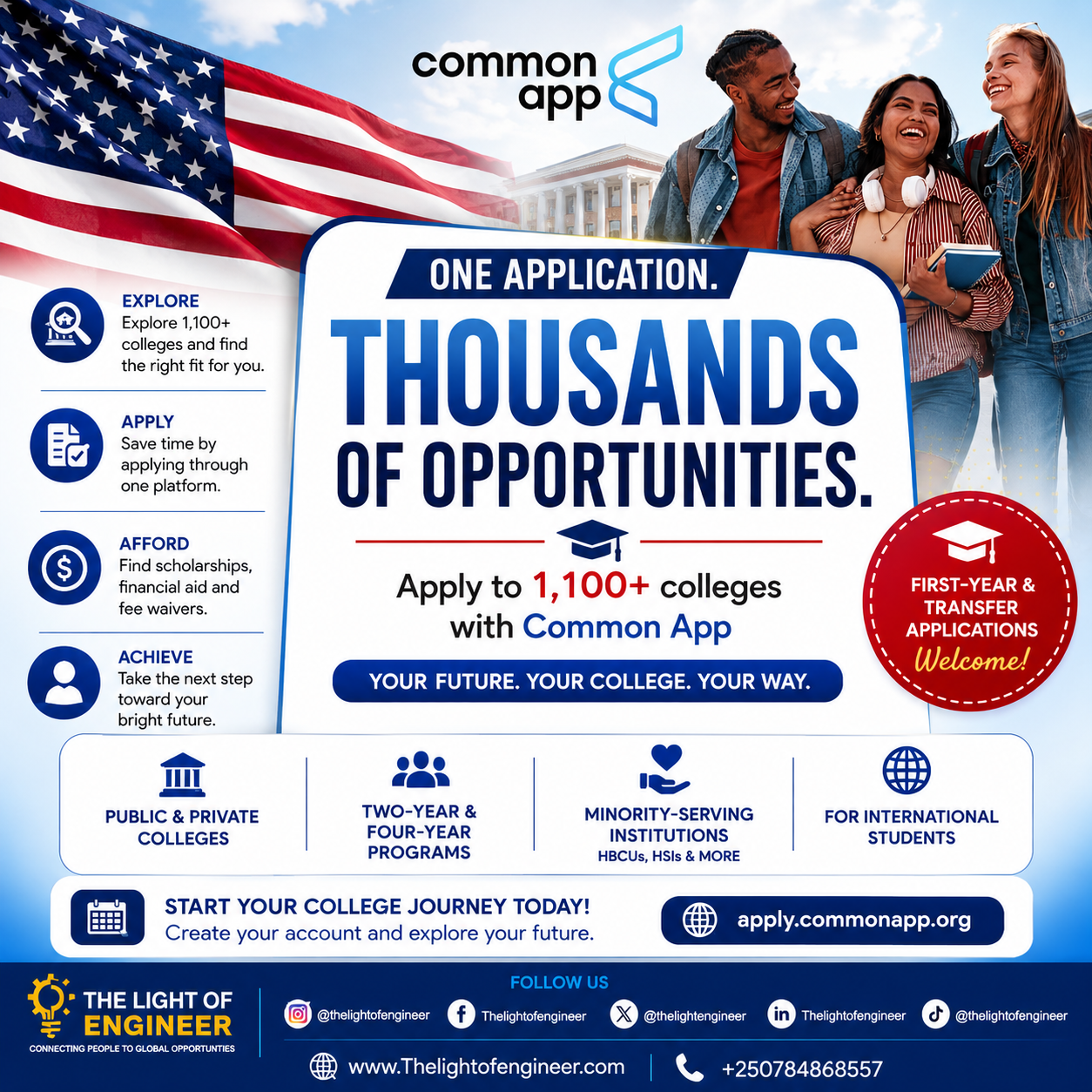
Common App currently provides access to more than 1,100 participating colleges and universities, including public and private institutions, two-year and four-year colleges, large and small universities, and minority-serving institutions. For international students, including students from Rwanda and other African countries, the platform can be a valuable starting point for identifying suitable universities and understanding their admission requirements.
It is important to note that Common App is not a single scholarship. It is an application platform used by participating colleges and universities. Each institution determines its own academic requirements, scholarships, financial-aid policies, application fees, deadlines, and admission decisions.
About Common App
The Common Application is an online college application platform created to make the university admission process more accessible and manageable for students.
Through one Common App account, students can create a personal profile, enter their academic information, search for participating colleges, add institutions to their college list, review individual requirements, and submit applications.
The platform also provides resources for students, counselors, teachers, recommenders, and colleges. Its broader mission focuses on access, equity, and integrity within the college admission process.
For prospective students, Common App can therefore serve as a central starting point for researching universities and organizing the application process.
Available Programs and College Options
Common App provides access to a wide range of participating colleges rather than offering one fixed list of academic programs. The actual degrees and majors available depend on the individual institution. Students can explore several categories of colleges and application pathways.
1. First-Year College Applications
The first-year application pathway is designed for students applying to college for the first time, generally after completing secondary or high school education.
Applicants can use Common App to provide their academic history, activities, essays, recommendations, and other information required by participating colleges.
2. Transfer Applications
Students who have previously attended college and want to continue their education at another institution can explore transfer opportunities through Common App where available.
Transfer applicants should carefully review each university's transfer-credit policies, admission requirements, available programs, and deadlines.
3. Two-Year Programs
Some participating institutions offer two-year undergraduate programs.
These programs can provide students with an opportunity to pursue an associate-level qualification or another two-year course of study, depending on the institution.
4. Four-Year Degree Programs
Common App also provides access to universities and colleges offering four-year undergraduate degrees.
Depending on the institution, students may find programs in areas such as:
- Engineering
- Computer Science
- Information Technology
- Artificial Intelligence
- Business and Economics
- Health and Life Sciences
- Social Sciences
- Natural Sciences
- Humanities
- Arts and Design
The availability of a specific major must always be confirmed through the individual university.
5. Public and Private Colleges
Students can explore both public and private institutions through the Common App network.
Universities differ significantly in tuition costs, financial aid, academic programs, location, campus size, admission requirements, and international student support.
6. Minority-Serving Institutions
Common App also includes minority-serving institutions, including Historically Black Colleges and Universities (HBCUs), Hispanic-Serving Institutions (HSIs), and other institutions.
These universities can provide additional opportunities for students seeking diverse academic communities.
Benefits of Common App
Common App offers several advantages to students who are applying to participating colleges.
1. Access to More Than 1,100 Colleges
Students can research a large network of participating institutions through one platform.
The college search tool allows applicants to explore institutions based on factors such as location, institution type, campus setting, enrollment size, financial aid, and application options.
2. Centralized Application Management
One of the main advantages of Common App is that students can create a central profile containing much of their personal and academic information. This can reduce repetitive work when applying to multiple participating institutions.
However, applicants should remember that individual colleges may require additional questions, essays, documents, or other materials.
3. Scholarship and Financial-Aid Resources
Common App provides resources related to scholarships, financial aid, application fees, and fee waivers.
Some participating colleges do not charge application fees, while eligible applicants may qualify for fee waivers at institutions that participate in the applicable program.
Students should always confirm the fee and financial-aid policies of each university.
4. Direct Admissions Opportunities
Common App also supports Direct Admissions opportunities offered by participating colleges.
Depending on the institution and its criteria, eligible students may receive admission offers based on information included in their Common App profile.
Because eligibility requirements vary, applicants should review the current requirements of each participating institution.
5. International Student Support
Common App provides resources specifically intended to help international students understand the college application process.
This can be particularly useful for students from Africa who are researching U.S. universities and need to understand application requirements, fees, financial aid, and other admission considerations.
Eligibility Criteria
There is no universal eligibility requirement for Common App because it is not itself a scholarship or degree program.
Eligibility is determined by the specific college, academic program, scholarship, financial-aid opportunity, or admission pathway selected by the student.
Applicants should generally:
- Apply to a college that participates in Common App.
- Select the appropriate application type, such as first-year or transfer.
- Meet the academic requirements established by the selected institution.
- Provide accurate personal and academic information.
- Meet the university's application deadline.
- Submit all required supporting documents.
- Meet any additional requirements for scholarships or financial aid.
International students may have additional requirements depending on their chosen university and program.
Therefore, students should always treat the individual university's official admission requirements as the final authority.
Required Documents
Common App does not impose one identical document checklist on every college. Each institution determines what applicants must submit.
Depending on the university and application type, students may be required to provide the following:
Academic Transcripts
First-year applicants should prepare their secondary school transcript, while transfer applicants may need college or university transcripts.
Academic Information
Applicants may need to provide information about their courses, grades, GPA, academic achievements, and educational history.
Personal Information
Students must complete the personal and educational information requested in their Common App profile.
Activities and Achievements
Applicants can provide information about extracurricular activities, leadership, volunteering, employment, community involvement, awards, and other significant experiences.
Essays and Personal Statements
Some colleges require a personal essay, while others may require additional institution-specific essays.
Applicants should carefully follow the instructions and word limits provided by each college.
Recommendation Letters
Some institutions require recommendations from teachers, counselors, or other appropriate individuals.
Students should contact their recommenders early to give them sufficient time to prepare and submit their recommendations.
Standardized Test Results
Testing policies vary between universities. Some colleges may require standardized tests, while others may be test-optional or follow different testing policies.
Applicants should verify the current testing policy of each institution before submitting an application.
Financial-Aid Information
Students seeking financial assistance may need to provide additional financial information.
The specific requirements depend on the university and the type of financial aid being requested.
Application Fee or Fee Waiver
Some colleges charge application fees, while others do not.
Eligible students may be able to request a fee waiver depending on the relevant Common App and university policies.
International applicants should carefully check whether the institution accepts the applicable fee waiver.
How to Apply Through Common App
The application process can be organized into the following steps.
Step 1: Research Your Universities
Begin by identifying colleges that offer programs aligned with your academic interests, career objectives, financial circumstances, and preferred study environment.
Consider:
- Academic programs and majors
- Tuition and other costs
- Scholarships and financial aid
- Location
- Admission requirements
- Application deadlines
- English-language requirements
- International student support
- Campus environment
Step 2: Create a Common App Account
Visit the official Common App application platform and create an account.
Use accurate personal information and an email address that you regularly monitor.
Official application portal: APPLY HERE
Step 3: Complete Your Common App Profile
Enter your personal, educational, academic, family, and activity information.
Review your information carefully to ensure that it is accurate and consistent with your official documents.
Step 4: Explore Colleges
Use the Common App college search tool to identify universities that match your academic and career goals.
Create a carefully considered college list rather than applying randomly to institutions.
Step 5: Review University Requirements
This is one of the most important stages of the process.
For every university on your list, check:
- Admission requirements
- Available degree programs
- Application deadline
- Application fee
- Fee-waiver policy
- Essay requirements
- Recommendation requirements
- Testing requirements
- Scholarship opportunities
- Financial-aid requirements
- International student requirements
Step 6: Prepare Your Documents
Gather your transcripts, academic records, essays, recommendation materials, test results where required, and other supporting documents.
Preparing these materials early can significantly reduce the risk of missing deadlines.
Step 7: Complete College-Specific Requirements
Some universities require additional questions, supplemental essays, documents, or other application components.
Complete all requirements shown for each institution.
Step 8: Review Your Application
Before submitting, carefully review every section of your application.
Pay particular attention to your:
- Personal information
- Academic history
- Grades and courses
- Activities
- Essays
- Recommendations
- College-specific questions
- Financial-aid information
- Fee or fee-waiver information
Make sure every statement and document is truthful and accurate.
Step 9: Submit Your Application
Submit each application before the specific university's deadline.
Do not assume that every Common App college has the same deadline. Application deadlines are determined by individual institutions.
Step 10: Monitor Your Application
After submission, regularly check your Common App account and email. Some universities may ask applicants to create an additional applicant portal after receiving the application. Continue monitoring communications until the admission and financial-aid process is completed.
Important Advice for International Students
Students applying from Rwanda, other African countries, or elsewhere outside the United States should begin preparing well in advance.
Pay particular attention to academic document requirements, English-language proficiency requirements, application deadlines, financial-aid procedures, and any additional requirements for international applicants.
Students should also understand the difference between university admission and financial aid.
Receiving an admission offer does not automatically mean that the university will provide full financial support. Financial assistance may be offered through merit scholarships, need-based aid, grants, institutional scholarships, or other funding arrangements.
Always confirm the exact funding conditions with the university.
Applicants should also ensure that every piece of information submitted is genuine and verifiable. False information or altered documents can seriously affect an application.
Why You Should Start Early
A competitive university application requires preparation rather than simply completing an online form.
Students need enough time to:
- Research universities and programs.
- Compare tuition and financial-aid options.
- Prepare academic documents.
- Develop strong essays.
- Contact recommenders.
- Review testing requirements.
- Complete financial-aid applications.
- Submit applications before deadlines.
Starting early also gives applicants time to correct errors and strengthen their applications.
A useful strategy is to create an application calendar showing each university, program, deadline, required documents, application fee, scholarship deadline, and application status.
Conclusion
Common App has become an important tool for students exploring higher education opportunities at participating colleges and universities. By bringing college discovery and application management into one platform, it can make the application process more organized and accessible.
Students can explore first-year and transfer opportunities, two-year and four-year institutions, public and private colleges, minority-serving institutions, and universities offering a wide range of academic programs.
However, applicants must remember that Common App does not replace the individual university's admission process. Every college can establish its own eligibility criteria, academic requirements, deadlines, application fees, scholarships, financial-aid policies, and supporting-document requirements.
For this reason, students should research carefully, prepare early, verify information through official university sources, and submit accurate applications before the relevant deadlines.
About The Light of Engineering
The Light of Engineering is a professional digital platform dedicated to connecting students, graduates, professionals, and job seekers with global opportunities.
The platform focuses on scholarships, jobs, professional internships, fellowships, AI and technology opportunities, and career-development resources. Its mission is to connect people with global opportunities and provide practical information that can support education and career development.
The Light of Engineering follows a professional content workflow that includes identifying opportunities, preparing informative and SEO-optimized articles, publishing opportunities professionally, sharing them across social media platforms, and engaging with its audience.
If you are searching for scholarships, jobs, internships, fellowships, technology opportunities, or career guidance, The Light of Engineering can help you discover opportunities and access practical application information.
- Visit The Light of Engineering: Learn more
- For official Common App information and the latest application requirements, always visit: Learn more
Start your research early, choose your programs carefully, prepare your documents professionally, and take every application deadline seriously. Your next educational opportunity could be the beginning of a transformative academic and professional journey.
Log in to join the discussion.
Your experience matters
Rate The Light of Engineering
Tell us about your experience discovering or applying for this opportunity. Reviews are checked before publication.