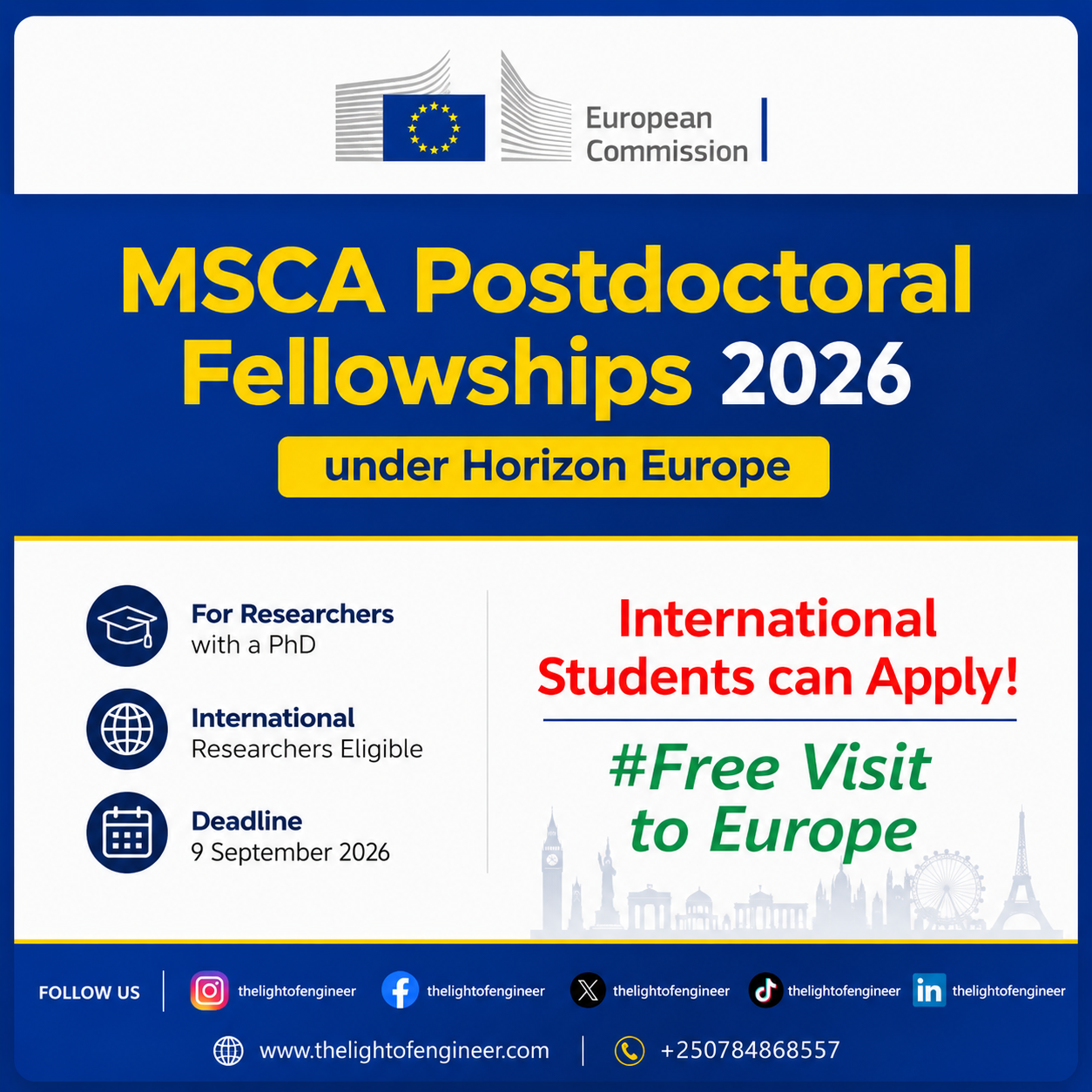
MSCA Postdoctoral Fellowships 2026 - European Commission
MSCA Postdoctoral Fellowships 2026: Fully Funded Research Opportunity for International Researchers
The Marie Skłodowska-Curie Actions (MSCA) Postdoctoral Fellowships 2026 are now open to excellent researchers holding a PhD who want to advance their research careers through international mobility, advanced training, and collaboration with leading academic and non-academic organisations in Europe and beyond.
Funded by the European Union under Horizon Europe, the MSCA Postdoctoral Fellowships support researchers in developing new skills, strengthening their research profiles, and gaining international, interdisciplinary, and inter-sectoral experience.
The 2026 call has an indicative budget of €399.05 million and is expected to support nearly 1,600 research projects. Applications must be prepared jointly by the researcher and a prospective host organisation.
Importantly, although the fellowship is sometimes described online as an opportunity for “international students,” this is a postdoctoral research fellowship for researchers who already hold a PhD. The official 2026 call is open to excellent researchers of any nationality, subject to the specific eligibility and mobility conditions.
MSCA Postdoctoral Fellowships 2026 at a Glance
|
Opportunity |
Details |
|
Programme |
Marie Skłodowska-Curie Actions |
|
Fellowship |
MSCA Postdoctoral Fellowships 2026 |
|
Funding programme |
Horizon Europe |
|
Funding body |
European Union |
|
Eligible researchers |
Excellent researchers holding a PhD |
|
Nationality |
Any nationality for European Postdoctoral Fellowships |
|
Duration |
12–24 months for European Postdoctoral Fellowships |
|
Indicative budget |
€399.05 million |
|
Application deadline |
9 September 2026, 17:00 CEST |
|
Expected results |
February 2027 |
|
First EU-funded projects |
May 2027 |
The official European Commission page confirms that the 2026 call opened on 9 April 2026 and closes on 9 September 2026.
What Are the MSCA Postdoctoral Fellowships?
The Marie Skłodowska-Curie Actions Postdoctoral Fellowships are designed to enhance the creative and innovative potential of researchers who hold a PhD and want to acquire new skills through advanced training and international, interdisciplinary, and inter-sectoral mobility.
The programme supports researchers undertaking international mobility to or between EU Member States and Horizon Europe Associated Countries, as well as mobility involving non-associated Third Countries, depending on the fellowship type.
Applications are submitted jointly by the researcher and a beneficiary organisation from either the academic or non-academic sector.
The scheme also supports researchers interested in moving between academia and other sectors. According to the European Commission, the programme is open to researchers seeking to reintegrate into Europe, researchers displaced by conflict, and researchers seeking to restart their research careers.
Types of MSCA Postdoctoral Fellowships
There are two main types of Postdoctoral Fellowships under the 2026 call.
1. European Postdoctoral Fellowships
European Postdoctoral Fellowships are open to researchers of any nationality.
Researchers can undertake a research and innovation project by moving to Europe from another country or by moving between countries within Europe.
The standard duration is 12 to 24 months.
This makes the European Postdoctoral Fellowship particularly relevant to international researchers who want to develop their research careers within the European research environment.
2. Global Postdoctoral Fellowships
Global Postdoctoral Fellowships are designed for European nationals or long-term residents who wish to conduct research with an organisation located outside the EU Member States and Horizon Europe Associated Countries.
The fellowship includes an outgoing phase of between 12 and 24 months in a non-associated Third Country, followed by a mandatory 12-month return phase to a host organisation located in an EU Member State or Horizon Europe Associated Country.
Therefore, international applicants should carefully determine which fellowship type they are eligible for before preparing their proposal.
Financial Support
The MSCA Postdoctoral Fellowships 2026 call has an indicative budget of €399.05 million.
The fellowship provides financial support intended to enable researchers to undertake their proposed research and mobility activities. The programme includes allowances associated with the fellowship, with the precise funding arrangements governed by the official Horizon Europe call conditions.
Applicants should consult the official call documentation for the complete financial conditions, applicable allowances, institutional arrangements, and funding rules.
Who Can Apply?
The MSCA Postdoctoral Fellowships are aimed at researchers who have already obtained a PhD and are seeking to strengthen their research experience and career development.
The official call states that European Postdoctoral Fellowships are open to researchers of any nationality. However, applicants must satisfy the specific eligibility and mobility requirements applicable to the call.
Applicants should therefore check the official call documentation carefully before submitting a proposal rather than relying only on general descriptions published by third-party websites.
Mobility Requirement
Mobility is a central component of the MSCA Postdoctoral Fellowships.
The programme is designed to promote international research mobility and expose researchers to different research environments, institutions, disciplines, and sectors.
For this reason, candidates should carefully review the mobility rules applicable to their proposed fellowship before applying.
Research Fields
The MSCA Postdoctoral Fellowships are open to all areas of research, including research covered by the Euratom Research and Training Programme, although specific eligibility conditions may apply to Euratom-related research areas.
Potential research areas may include, among others:
- Chemistry
- Physics
- Mathematics
- Life Sciences
- Environmental and Geosciences
- Information Science and Engineering
- Economic Sciences
- Social Sciences and Humanities
The important point is that applicants should develop a strong, well-defined research and innovation project that aligns with the objectives and evaluation requirements of the MSCA programme.
Host Organisations
Applicants do not apply independently without a host organisation.
The European Commission states that applications are made jointly by the researcher and a beneficiary in the academic or non-academic sector. Potential host organisations can include universities, research institutions, companies, public institutions, hospitals, museums, NGOs, and other eligible organisations.
Finding an appropriate supervisor and host organisation is therefore one of the most important stages of preparing a competitive application.
Application Timeline
The official MSCA Postdoctoral Fellowships 2026 timeline is as follows:
9 April 2026: Call for proposals opened.
9 September 2026 at 17:00 CEST: Application deadline.
February 2027: Applicants are expected to receive notification of the call results.
April 2027: Indicative grant agreement signature period for successful projects.
May 2027: First EU-funded projects are expected to start.
Applicants are strongly encouraged to submit their proposals before the final deadline rather than waiting until the last day.
How to Prepare a Strong MSCA Application
Preparing an MSCA Postdoctoral Fellowship proposal requires more than simply completing an online application form.
Researchers should begin by identifying a suitable host organisation and potential supervisor whose expertise aligns closely with the proposed research.
The next step is to develop a clear research and innovation project that demonstrates scientific quality, originality, feasibility, and potential impact.
Applicants should also demonstrate how the fellowship will contribute to their professional development and how the international mobility and training activities will strengthen their long-term research career.
The official MSCA guidance recommends working closely with the prospective supervisor and host organisation during the proposal preparation process.
How to Apply for MSCA Postdoctoral Fellowships 2026
Applications are submitted through the EU Funding & Tenders Portal.
Before applying, candidates should review the official call conditions, identify a suitable host organisation, work with the prospective supervisor, prepare the research proposal and supporting information, and ensure that the complete application is submitted before the deadline.
The European Commission recommends submitting proposals as early as possible to avoid technical or last-minute problems.
Official Application Website: MSCA Postdoctoral Fellowships 2026 Official European Commission Page
EU Funding & Tenders Portal: EU Funding & Tenders Portal
Important Note About MSCA 2027
Applicants searching for “MSCA Postdoctoral Fellowships 2027” should be aware that the official European Commission funding calendar currently lists the 2027 Postdoctoral Fellowships as a forthcoming call.
The official listing indicates that the MSCA Postdoctoral Fellowships 2027 call is expected to open on 7 April 2027 and close on 8 September 2027 at 17:00 CEST.
Therefore, the opportunity currently accepting applications is the MSCA Postdoctoral Fellowships 2026, with a September 2026 deadline.
Why Researchers Should Consider This Opportunity
The MSCA Postdoctoral Fellowships provide researchers with an opportunity to strengthen their academic and professional profiles through international mobility, advanced training, research collaboration, and exposure to different research environments.
The programme can also help researchers establish international networks and develop transferable skills that can contribute to long-term careers in academia, industry, public institutions, and other research-related sectors.
For researchers seeking international research experience after completing a PhD, the MSCA Postdoctoral Fellowship represents a significant European research and career-development opportunity.
Frequently Asked Questions
Is the MSCA Postdoctoral Fellowship fully funded?
The MSCA Postdoctoral Fellowships provide EU funding and allowances to support researchers during the fellowship. Applicants should consult the official call documentation for the complete financial terms and applicable allowances.
Can international researchers apply?
Yes. European Postdoctoral Fellowships are open to researchers of any nationality, provided they meet the applicable eligibility and mobility requirements.
Do I need a PhD?
Yes. The programme is designed for researchers holding a PhD.
How long is the fellowship?
European Postdoctoral Fellowships have a standard duration of 12 to 24 months. Global Postdoctoral Fellowships have a 12–24-month outgoing phase followed by a mandatory 12-month return phase.
What is the deadline?
The deadline for the current MSCA Postdoctoral Fellowships 2026 call is 9 September 2026 at 17:00 CEST.
When will the results be announced?
The European Commission indicates that applicants are expected to receive notification of the results in February 2027.
Where can I apply?
Applications are submitted through the European Union's Funding & Tenders Portal after preparing the proposal with the prospective host organisation and supervisor.
Final Advice for Applicants
If you are eligible for the MSCA Postdoctoral Fellowships 2026, do not wait until the final day to prepare your application. Start by identifying a suitable host institution and supervisor, develop a strong research concept, carefully review the official eligibility and mobility requirements, and allow sufficient time for proposal development and submission.
Because MSCA applications are highly competitive, applicants should rely on the official European Commission documentation for the definitive eligibility, funding, evaluation, and submission requirements.
The Light of Engineering is committed to sharing verified scholarships, fellowships, jobs, internships, and professional opportunities to help students, graduates, researchers, and professionals access global career opportunities. Our editorial approach prioritizes verified opportunities and professionally prepared information for our audience.
For the latest official information and application instructions, always refer to the European Commission's Marie Skłodowska-Curie Actions website.
Official Source: European Commission Marie Skłodowska-Curie Actions
Application Deadline: 9 September 2026 at 17:00 CEST
Expected Results: February 2027
Indicative Budget: €399.05 million
Current Status: Open
Log in to join the discussion.
Your experience matters
Rate The Light of Engineering
Tell us about your experience discovering or applying for this opportunity. Reviews are checked before publication.